
Why the Resin Gets the Blame
"We tested it in the lab and the film was perfect. Six weeks in service and it's coming off in sheets."
Peeling, cracking and chalking are the three most common complaints in automotive exhaust, appliance and industrial equipment coatings — and in nearly every case the root cause is the inorganic filler, not the resin.

The Three Failure Modes at a Glance
Symptom | Root cause | What fixes it |
Peeling / delamination | Thermal expansion mismatch, plus oxidation under the film | Frit that densifies in service, CTE matched to the substrate |
Cracking / mud-cracking | No viscous flow to relieve thermal strain | Frit with a softening range below the service temperature |
Chalking / yellowing / gloss loss | Binder decomposes faster than the ceramic network forms | Frit flow onset timed to binder decomposition |
Peeling has two causes working together: the coating and the metal expand at different rates, loading the interface with shear stress on every heat cycle; and a film that stays porous lets oxygen through to grow an oxide layer underneath. A frit that densifies in service closes that path — densification, not thickness, blocks oxygen ingress.
Cracking is a strain-accommodation problem: either the filler never softened, leaving loose powder held together by degraded resin, or the film is too rigid to flex. A frit that softens below the service temperature flows viscously and relieves the stress instead of fracturing.
Chalking means the binder is degrading faster than the inorganic network replaces it. The frit's flow onset must coincide with the binder's decomposition window — a gap between the two is where chalking begins.
Why One Powder Usually Cannot Do All Three
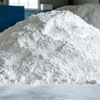
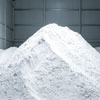
No single powder satisfies all three requirements — a frit that flows early enough to relieve strain may over-sinter at peak temperature, while one that resists peak temperature may never fuse enough to densify. Hence graded multi-frit systems: a low-melting fraction seals the surface while the binder is still decomposing, a mid-range fraction keeps the film continuous through the middle of the range, and a high-melting fraction holds the barrier intact at peak temperature.

A Worked Example: Exhaust Coating
A stainless steel exhaust manifold coating, peaking at 700–800°C with rapid heating and cooling, showed cracking after the second heat cycle and flaking at the flange within two months.
Original single-powder system | Graded glass frit system | |
Filler | Single silicon-based powder, full melting ≈ 900°C — above service temperature | Graded frit, ≈ 600–900°C, CTE matched to 304 stainless steel |
Film formation | Never fused; held together only by the silicone binder | Densifies in service into a continuous ceramic network |
Service result | Cracking after the 2nd heat cycle; flaking at the flange within 2 months | Repeated heat cycles without cracking; intact after 12 months |
The Takeaway
The resin gets the blame, but the filler decides the outcome — all three failure modes are interfacial and structural problems set by the inorganic phase. Choose the frit by service window and CTE, not by melting point alone, and use a graded system where the duty cycle is wide. Four limits are worth knowing up front: substrate preparation is not negotiable, below ~20 µm there is too little material for a continuous ceramic network, above ~1000°C a high-silica or fully ceramic system is required, and a thermally optimised frit is not automatically acid-, alkali- or chloride-resistant.
Anywhere Powder
Anywhere Powder supplies low-melting glass powders and ceramic-forming functional powders for high-temperature coatings, with full melting temperatures from approximately 330°C to 1350°C, available as single grades or pre-blended multi-frit systems.
Have a coating failure to diagnose? Send us your substrate, service temperature and current formulation, and our technical team will propose a frit system and ship a free 500 g sample for your own bake test.


